
SuperAPS Intelligent Production Scheduling System
SuperAPS leverages AI-driven algorithms and multi-factor constraint optimization to build an enterprise-grade intelligent scheduling system for discrete and process manufacturers: one central planning hub at headquarters plus N coordinated execution sites. This transforms scheduling from experience-based decisions into optimal, data-driven outcomes.
Product Details
SuperAPS Enterprise Intelligent Production Scheduling System
Core ValueSuperAPS leverages AI-driven algorithms and multi-factor constraint optimization to build an enterprise-grade intelligent scheduling system for discrete and process manufacturers: one central planning hub at headquarters plus N coordinated execution sites. This transforms scheduling from experience-based decisions into optimal, data-driven outcomes.
This solution is designed for headquarters and multi-site manufacturing groups to address core challenges such as manual scheduling, cross-site collaboration difficulties, urgent order insertion, material availability, and production capacity bottlenecks. It covers the full spectrum of planning—from mid-to-long-term capacity planning down to line-level operational scheduling—and provides deployment models, implementation roadmaps, and value measurement metrics.
Core Value
🧠 Smart Decision-Making: Automatically generates optimal production schedules using an AI-powered constraint solver.
⚡ High Performance: Solves 1000+ tasks in seconds to meet the needs of large-scale manufacturing enterprises.
🔄 Flexible Adaptation: Dynamic strategy switching for diverse production scenarios and business needs
📊 Visual Control: Multi-dimensional Gantt charts for real-time monitoring of production progress and resource status.
🚀Core Technologies
🧠 Intelligent Scheduling Solver Engine
Hybrid Solving Strategy: Leverages the Timefold Solver constraint engine to dynamically switch based on scenario, supporting multi-solver collaborative optimization.
Multi-objective optimization: Simultaneously optimize on-time delivery rate, resource utilization, and equipment changeover costs.
Dynamic Constraint System: Configurable hard and soft constraints at runtime for flexible business rule adjustments.
Incremental computation: Efficiently solves large-scale problems, completing 1000+ tasks within 5 minutes.
Real-time progress monitoring: WebSocket pushes solution progress and status updates in real time.
01 Industry Background and Scheduling Pain Points
Discrete manufacturing (machining, equipment, electronics, auto parts, etc.) and process manufacturing (chemicals, pharmaceuticals, food, new materials, etc.) face distinct yet equally challenging planning and scheduling issues:
Dimension | Common Pain Points in Discrete Manufacturing | Typical Pain Points in Process Manufacturing |
|---|---|---|
Scheduling Complexity | Complex processes, diverse process routes, and strong constraints on alternative resources and tooling | Continuous production, batch/lot constraints, and high changeover costs. |
Collaboration Challenges | Difficulty in aligning order allocation, capacity sharing, and delivery commitments across multiple sites. | Cross-site linkage of material balance, energy, and utility constraints |
Common Consequences | Frequent rush orders, high WIP inventory, low kit completion rate, and delivery delays. | High changeover losses, low batch utilization, and coexisting quality fluctuations and inventory issues. |
Current approach | Excel-based scheduling relying on veteran expertise: one version per person, results non-reproducible. | Rule-based coarse ranking makes it difficult to sustain optimal capacity and material utilization. |
Under the group model of "1 HQ + Multiple Bases," issues are amplified: HQ lacks a holistic view, bases operate in silos, order allocation relies on experience, capacity data is opaque, and cross-base transfers depend on phone calls—preventing optimal group-level decision-making.
02 Core Philosophy: AI-Driven Algorithms for Optimal Multi-Factor Solutions
2.1 Concept
SuperAPS frames the production scheduling problem as a multi-objective, multi-constraint combinatorial optimization challenge. It identifies the globally optimal (or near-optimal) feasible schedule by balancing key objectives—such as delivery dates, capacity, cost, and utilization weights—while strictly adhering to all hard constraints. The system also supports rolling rescheduling. Key features:
Algorithm-drivenNot a mere stacking of rule engines, but a combination of constraint modeling and intelligent solving. Scheduling quality is explainable, reproducible, and comparable.
multi-factorConsiders multiple factors simultaneously—lead time, capacity, materials, processes, priority, cost, changeovers, and resource balancing—rather than optimizing for a single objective.
Optimal SolutionSearch for near-optimal solutions within the feasible solution space and quantify their quality using KPIs, moving beyond "just any valid schedule."
2.2 Multi-Factor Model
Factor Category | Type | Description |
|---|---|---|
Delivery Lead Time Factor | Hard Constraints / Objectives | Order promise delivery date, early/late penalty, priority weight |
Capacity Factor | Hard constraint | Equipment/Line Availability, Shift Calendar, OEE Calculation, Bottleneck Identification |
Material Factor | Hard constraint | Material kit readiness, in-transit/in-stock, BOM-level pull, long-lead items |
Process Factor | Hard constraint | Process Routes, Operation Sequences, Alternate Resources, Tooling and Molds, Parameters and Batch Rules |
Priority Factor | Target | Customer Tier, Order Type, Rush Order Weight, In-Process Continuity |
Cost Factor | Target | Changeover costs, overtime costs, and inter-facility transfer/transportation costs |
balance factor | Target | Capacity load balancing, personnel/equipment utilization balance, WIP level |
Note: The factor list is configured based on industry and factory status. Discrete and process manufacturing share the same solving engine but use different constraint templates.
03 Overall Architecture: 1 Headquarters + Multiple Sites
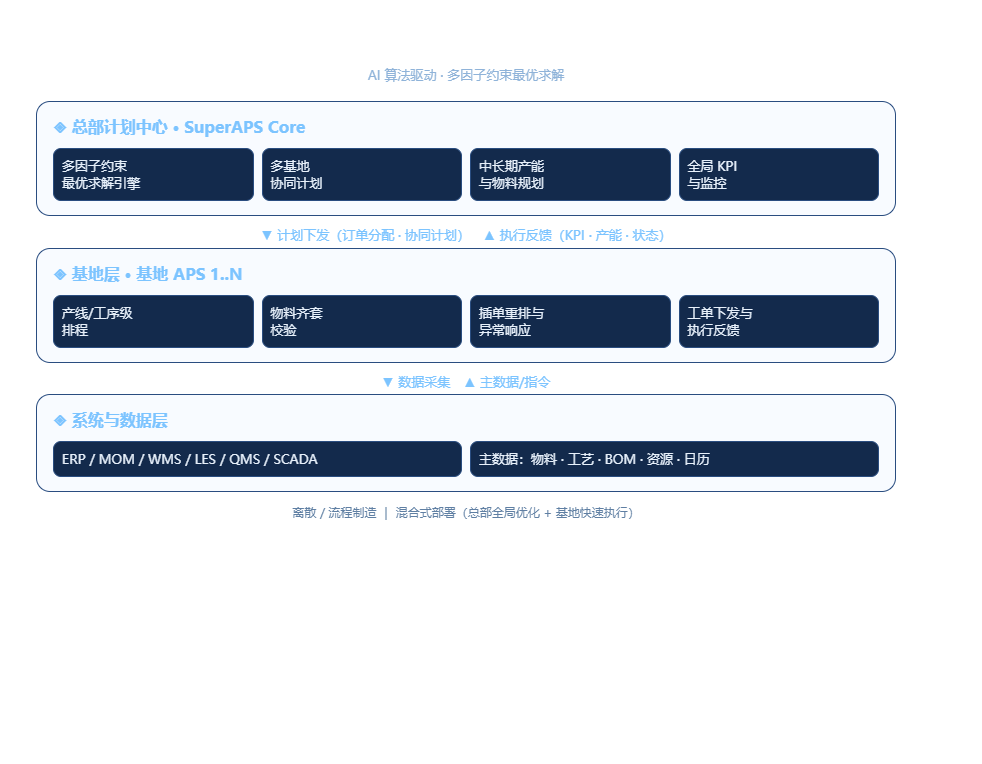
SuperAPS uses a two-tier architecture: "Headquarters Planning Center + Base Collaborative Execution." The headquarters manages global optimization and coordination, while bases handle local execution and rapid response.
3.1 HQ Planning Center Responsibilities
Global Order Pool Management & Multi-Site Allocation (Optimized for Capacity, Cost, and Lead Time)
Mid-to-long-term capacity planning, bottleneck resource forecasting, and investment recommendations
Multi-site collaboration: inter-site transfers, capacity sharing, and group-level delivery commitments
Unified master data and algorithm model governance, global KPI monitoring
3.2 Base Execution Layer Responsibilities
Receive headquarters plan and execute production line/process-level detailed scheduling.
Material completeness verification and shortage alerts, work order dispatch and execution feedback
Rapid rescheduling for rush orders, equipment failures, and quality stoppages
Base-level KPIs are reported to headquarters to complete the feedback loop.
04 Core Features
Medium- and Long-Term Plan (MPS)Aggregate requirements, validate rough-cut capacity, and forecast long-lead materials to generate the Master Production Schedule (MPS) and capacity load.
Short-Term Production Scheduling (DPS)Production line and operation-level detailed scheduling, minute/hour-level job planning, and automatic Gantt chart generation.
Multi-site collaborative scheduling: Intelligent order routing, capacity sharing, cross-facility transfer recommendations, and delivery commitment linkage.
Rush Orders and ReschedulingMinimize rescheduling impact for rush orders; trigger local rescheduling upon exceptions (downtime, material shortage, quality issues).
Material Kitting and PullKit validation, shortage alerts, and pull-based triggering integrated with WMS/LES.
Simulation vs. KPI Comparison: Multi-scenario simulation and drilldown with quantitative KPI comparisons, including on-time delivery rate, equipment utilization, and changeover frequency.
Production Schedule Board & MonitoringGantt charts, load charts, bottleneck analysis, and exception center to support collaboration between planners and the shop floor.
Rule and Factor ConfigurationVisually configure constraint weights, priority strategies, and changeover matrices. Algorithmic policies are maintainable.
05 Algorithm and Solver Engine
5.1 Solve Architecture
SuperAPS uses a "constraint modeling + hybrid solving" engine to balance solution quality and speed.
Constraint Modeling LayerConvert orders, resources, processes, materials, and calendars into a unified constraint model (hard constraints + soft constraints + objective function).
Solver LayerHeuristic algorithms (fast rule-based solving) + Meta-heuristics (near-optimal search via tabu search, genetic algorithms, simulated annealing, etc.) + Mathematical programming (exact solutions for small-scale problems). Mixed scheduling strategies automatically selected based on scenario scale.
Rolling Production SchedulingReorder by shift/day roll, balancing stability and responsiveness with a frozen window + scrolling window strategy.
Solve quality metricsTarget values, solution time, and KPI comparison report; publish only after "solution review."
5.2 Performance Targets (Recommended Acceptance Criteria)
Typical scale (e.g., 500+ tasks, 30+ resources): single solve time ≤ 3 minutes [validated with actual data]
Achieve an X% increase in KPIs such as on-time delivery rate and equipment utilization compared to current baseline [verified against pilot baseline].
06 1 HQ + Multi-Site Deployment
Mode | Use Cases | Benefits | Key Points |
|---|---|---|---|
Centralized (Headquarters-wide deployment) | Strong headquarters control and high standardization at base locations. | Unified models, centralized data, and global optimization are easily achievable. | High demands on headquarters network and computing resources; offline disaster recovery at the base must be ensured. |
Distributed (Independent Deployment per Site) | Highly variable regional operations require local high availability. | Self-managed base, fast response, offline capable | Models and master data must be centrally distributed by headquarters; coordination is achieved via APIs. |
Hybrid (Recommended) | Typical forms of group structures | Centralized global optimization with rapid local execution, balancing peak efficiency and resilience. | Define the scope of headquarters/base plans and data synchronization mechanisms. |
Recommendation: For multi-site enterprise scenarios, prioritize hybrid deployment. Headquarters should run global collaborative planning, while sites handle detailed scheduling and rapid rescheduling.
07 integrates with surrounding systems
System | Integrated Content | Direction |
|---|---|---|
ERP | Orders, BOMs, Material Inventory, Procurement in Transit, Cost Master Data | Bidirectional |
MES | Work Order Dispatch, Operation Reporting, Equipment Status, Actual Production Feedback | Bidirectional |
WMS / LES | Inventory kitting, inbound/outbound, and material pull commands | Bidirectional |
Quality Management System | Linkage between quality stoppage and inspection plan constraints on production scheduling | One-way dominant |
SCADA / Device Layer | Device status and OEE data to support capacity model calibration | One-way collection |
Integration follows the principles of "unified master data, standardized interfaces, and event-driven architecture" to reduce point-to-point development.
08 Implementation Roadmap (Recommended in Phases)
Stage | Key Actions | Phase Deliverables |
|---|---|---|
P0 Preparation Phase (1 Months) | Current state assessment, master data governance, production scheduling rules and factor modeling, pilot site selection and scope confirmation | Production Scheduling Status Report, Factor Model v1.0, Pilot Plan |
P1 Pilot Period (1 Quarters) | Pilot base detailed scheduling launch, algorithm parameter tuning, and KPI baseline comparison | Pilot Site Operations and Value Validation Report |
P2 Promotion Period (2 quarters) | Multi-site rollout, HQ coordination plan launch, and comprehensive integration with surrounding systems | 1 HQ + N Base integrated operations |
P3 Deepening Phase (Ongoing) | Continuous algorithm strategy optimization and deep integration with other digital factory systems | Group-level Intelligent Production Scheduling and Operations System |
09 Value Metric
Value measurement follows "baseline first, metrics second": collect current KPI baselines before launch, compare against them on a periodic basis after launch, and validate using actual measurements.
Delivery: On-time Order Delivery Rate, Plan Achievement Rate, Rush Order Response Time
Efficiency: Production scheduling time (days → minutes), capacity utilization, changeover frequency
Inventory: WIP level, kit completeness rate, downtime duration due to material shortage
Cost Categories: Overtime and Transfer Costs; Obsolescence and Expiration Risks
10 Risks and Mitigations
Risk | Impact | Handle |
|---|---|---|
Inaccurate master data (BOM/Process/Resources) | Distorted production scheduling results | P0: Govern pilot data; verify algorithm results against field reality via dual-track validation before release. |
Line 1 does not accept algorithm-based scheduling. | Implementation stalled; plans remain ineffective. | Planners participate in modeling and reviews; KPI comparisons demonstrate superiority over experience-based scheduling; manual adjustments retained with version history. |
Slow exception response | Production scheduling is disconnected from actual operations. | Event-driven local re-renders with anomaly centers; frozen window strategy balances stability and agility. |
Multi-site collaboration conflict of interest | Split order disputes, uncooperative execution | Transparent order-splitting rules, unified group-level assessment criteria; configurable and auditable rules. |
11 Next (Decision Entry)
Please provide a decision from leadership on the following matters:
Approve SuperAPS direction; confirm target industry and pilot base scope.
Confirm Deployment Mode (Recommended: Hybrid – HQ Global Planning + Site-Level Scheduling)
Authorize P0 Phase: Current State Assessment and Master Data Governance Launch
Confirm pilot period value acceptance criteria (KPI baseline comparison method)

Related Products
Industrial Metaverse Platform
Bridging the physical and digital to redefine industrial future
TPM Equipment Maintenance - Predictive Maintenance System
Quantitative outcomes of TPM predictive maintenance are typically measured across five dimensions: downtime, cost, efficiency, asset health, and inventory.