

Smart Operations Data Decision Platform
Cloud platform for superior enterprise operations and collaborative efficiency. Connects R&D, manufacturing, supply chain, sales, and service with integrated data, deep-dive metrics, and intelligent decision-making.
Product Details
Smart Operations Data Decision Platform
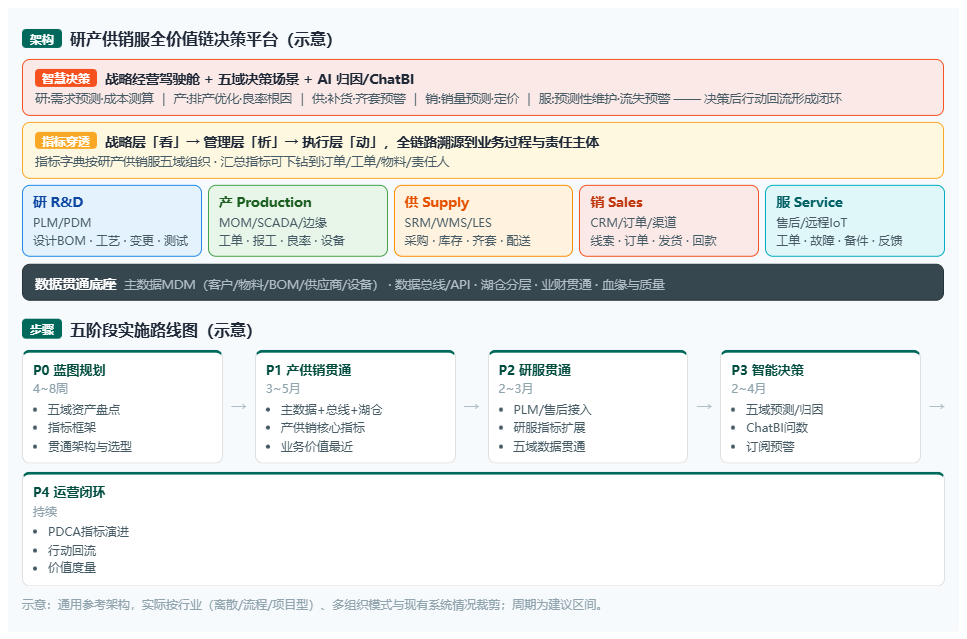
Core Value: Upgraded from a traditional "Business Analytics Platform" toEnd-to-End Decision Hub— Covers five core business domains: R&D, manufacturing, supply chain, sales, and service through «Data Integration → Metric Drill-down → Smart Decision-makingThree-tier capabilities that enable an end-to-end closed loop from strategic goals to frontline execution. The goal is to achieve full data integration across the core value chain of R&D, manufacturing, supply, sales, and service—moving data from "accessible" to "actionable for decision-making."
I. Platform Advantages
Seamless Integration = Break down silos across five domains and unify data standards with business facts.Link a single material change across the entire chain: BOM, production orders, and customer orders.
Five-Domain Data Asset Core:
Business Domain | Core System | Key data for integration |
|---|---|---|
Research | PLM/PDM | Design BOM, Process Route, Change Records, Test Data |
Product | MOM, SCADA / Edge Intelligence, QMS | Production Order, Work Reporting, WIP, Quality / Yield |
Supply | SRM, WMS, LES | Purchase Orders, Inventory, Kit Completion, Delivery |
Sell | CRM, Orders/Channels, E-commerce | Leads, Opportunities, Orders, Shipments, Payments |
服 | After-sales work orders, remote IoT operations | Service Records, Faults, Spare Parts, Customer Feedback |
methods for integration:
Master data firstUnified Customer, Material, BOM, Supplier, Equipment, and Organization are the "primary keys" linking these five domains.
Integrated Architecture: Data Bus / API + Real-time CDC + Batch Sync; Lakehouse Layers (ODS → DWD → DWS → ADS)
Integrated Finance and Business OperationsConnect the full business process from procurement, production, and sales to finance, enabling integrated analysis of operational and financial data — an end-to-end flow from lead to cash collection, purchase to payment, and planning to cost.
Quality assurance for seamless integrationEnd-to-end monitoring, data lineage, and consistent metrics across domains
II. Metric Drill-Down
Drill-down = Layered Business Analysis + End-to-End TraceabilityEstablish a three-tier operating analysis framework—strategic, management, and execution—centered on the logic of "control budget, track growth, identify root causes, and forecast future performance" to enable full-chain traceability from financial metrics down to business processes and responsible owners.
Strategic Layer (Decision-makers' View): Executive Cockpit — Revenue, Profit, Cash Flow, Order Fulfillment, Inventory Turnover, Cost Fluctuations
Management (Manager "Xi")Five-Domain Metrics: R&D Progress & Cost, Production OEE, Supply Kit Completion Rate, Sales Achievement Rate, and Service Satisfaction
Execution Layer (Frontline "Action"): Process Metrics — Ticket Progress, Inventory Levels, Station Efficiency, Service Ticket SLA
Penetration ExampleDeclining gross margin → Drill down to orders/products → Production work orders → Material cost composition → Responsible department and root cause (material, labor, or overhead). Organize metrics according to the R&D, production, supply, sales, and service domain metric dictionary. Implement strategic-to-execution penetration management using "OSM goal decomposition + metric monitoring + PDCA closed-loop."
3. Smart Decision-Making (What to Decide, How to Close the Loop)
Five-Domain Decision Scenarios:
Business Domain | Typical Intelligent Decision-Making Scenarios |
|---|---|
Research | Demand/Selection Forecasting, Target Cost Estimation, R&D Delay Alerting, Change Impact Assessment |
Product | Production scheduling optimization, yield root cause analysis, quality anomaly alerts, and bottleneck identification |
Supply | Restock forecasting, kit shortage alerts, procurement price prediction, supplier performance evaluation |
Sell | Sales Forecasting (Closed-loop: Predict → Execute → Review → Optimize) | Yonyou Group | Pricing & Promotion | Inventory Balance |
服 | Predictive maintenance, spare parts demand forecasting, customer churn prediction, and service satisfaction attribution |
Decision Loop (Critical)The "view" by decision-makers and the "analysis" by managers are just entry points; execution must translate into action. Guangyuan Data: Metrics → AI-driven attribution insights → Actionable recommendations (ChatBI / Insight Agent) → Feedback loop of action outcomes. Note: AI serves as an analytical tool to support, not replace, human decision-making.
IV. Implementation Steps (Phased Full-Chain Approach)
Stage | Cycle | Objectives and Key Actions | Output |
|---|---|---|---|
P0 Blueprint Planning | 4–8 weeks | Five-domain data asset inventory, metric framework design, and architecture integration with selection | "Five-Domain Indicator Dictionary v1" and Blueprint |
P1: End-to-End Integration of Production, Supply, and Sales | 3–5 | Master Data + Data Bus + Lakehouse; Launch of core production, supply, and sales metrics (highest business value in the near term) | Clear visibility across production, supply, and sales |
P2 Research-to-Service Integration | 2–3 | Integrate PLM and After-Sales data to expand service metrics. | Five-domain data integration |
P3 Intelligent Decision | 2–4 | Five-Domain Forecasting / Attribution / ChatBI / Subscription Alerts | From "Viewing Data" to "Making Decisions" |
P4 Operations Closed Loop | Continue | PDCA metric evolution, action feedback loop, and value measurement | End-to-end decision loop |
V. Implementation Strategy
Connect but don't govern → Five domains clash; drill-down distorts data.
Metrics remain at the summary level and do not roll down to business processes or accountable owners.
Decisions that are only "viewed" but not "acted upon" break the execution loop, turning the platform into a static dashboard.
Challenging to collect R&D service data (PLM / After-sales heterogeneity) → Start with high-frequency value domains, then gradually expand coverage.
AI-Driven Decisions → Compliance & Liability Risks: Uphold "AI-Assisted, Human-Controlled"

Related Products
Enterprise AI Knowledge Platform
Unify enterprise knowledge scattered across documents, cloud storage, and business systems into a centralized hub that is manageable, queryable, searchable, and ready for AI consumption. Built not just to store knowledge, but to transform it into an assetized, service-oriented, and intelligent resource—the essential fuel for RAG-based Q&A, Copilots, and AI agents.
SuperBI Data Analytics Platform
Powerful data analytics tool to help businesses unlock data value